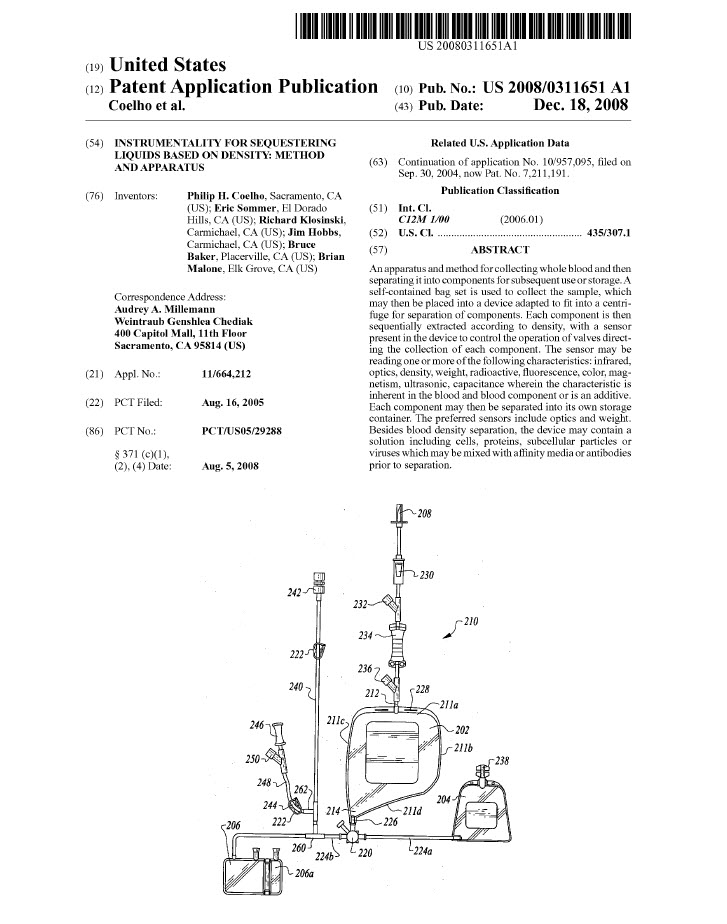
Patent 8,066,127
Title: Instrumentality for Sequestering Liquids Based on Density: Method and Apparatus
Inventors: Philip H. Coelho, Eric Sommer, Richard Klosinski, Jim Hobbs, Bruce Baker, Brian Malone
Assignee: Thermogenesis Holdings Inc. (originally Thermogenesis Corp.)
Filed: August 16, 2005
Granted: November 29, 2011
Overview
This patent describes a closed-system apparatus for separating whole blood into its component parts using density-based centrifugal separation. The technology enables automated, sequential extraction of blood components (red blood cells, white blood cells, platelets, and plasma) into individual storage containers.
Key Innovation
The system dramatically streamlines blood separation from a labor-intensive 16-step manual process to an automated 7-8 step procedure that takes approximately 25 minutes. Most importantly, it eliminates contamination risks by maintaining a sterile, closed system throughout the entire process (versus traditional open-system processing).
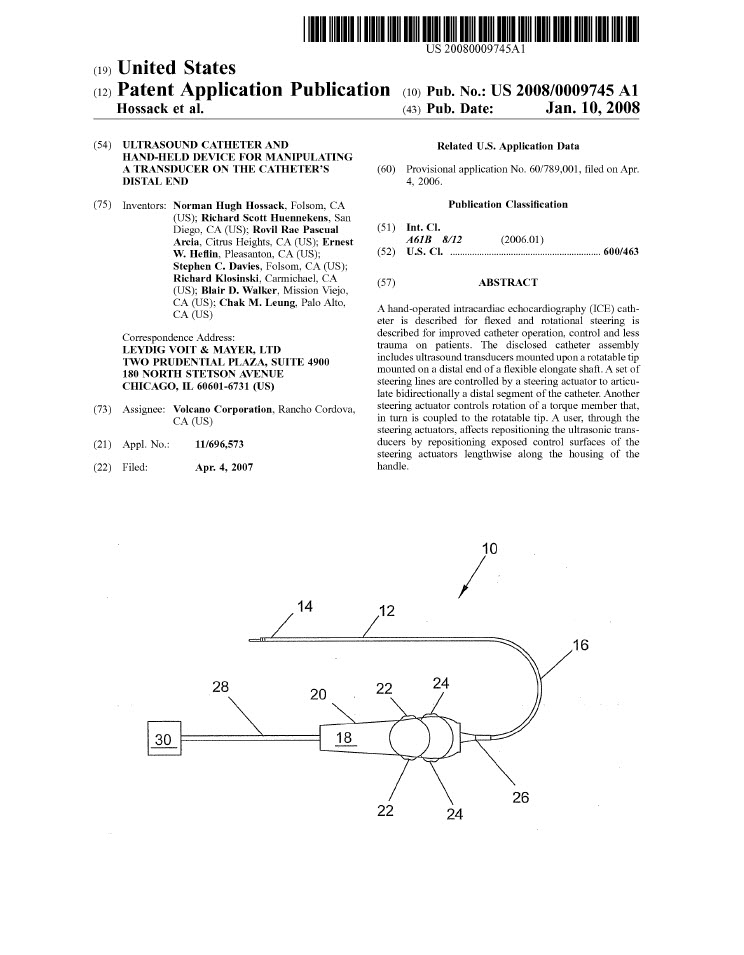
Patent 8,840,560
Title: Ultrasound Catheter and Hand-Held Device for Manipulating a Transducer on the Catheter’s Distal End
Inventors: Norman Hugh Hossack, Richard Scott Huennekens, Rovil Rae Pascual Arcia, Ernest W. Heflin, Stephen C. Davies, Richard Klosinski, Blair D. Walker, Chak M. Leung
Assignee: Philips Image Guided Therapy Corp (originally Volcano Corp)
Filed: April 4, 2007 (Priority: April 4, 2006)
Granted: September 23, 2014
Expires: September 3, 2029
Overview
This patent describes a hand-operated intracardiac echocardiography (ICE) catheter system with combined flexed and rotational steering capabilities. The device enables physicians to control ultrasound transducers at the catheter’s distal end with improved precision while reducing patient trauma.
Key Innovation
The system provides single-handed operation via an integrated handle design with dual, independent steering controls, allowing physicians to precisely position the ultrasound transducer within the heart using simultaneous rotation and flexion.
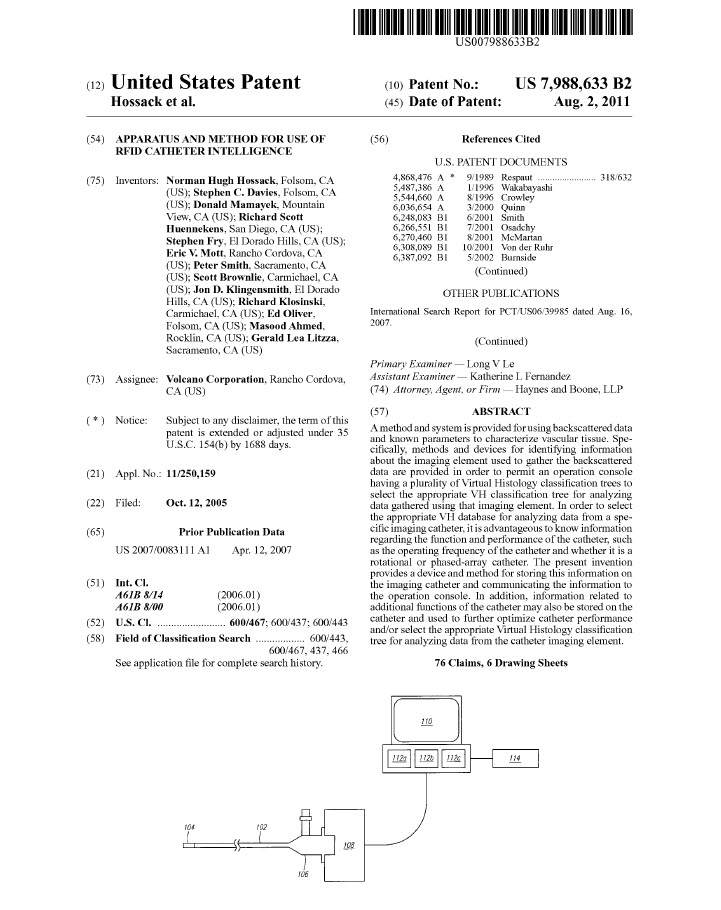
Patent 9,101,298
Title: Apparatus and Method for Use of RFID Catheter Intelligence
Inventors: Norman Hugh Hossack, Stephen Charles Davies, Donald Mamayek, Richard Scott Huennekens, Stephen M. Fry, Eric Vaughn Mott, Peter Smith, Scott Tennant Brownlie, Jon David Klingensmith, Richard Chester Klosinski Jr., Edward Anthony Oliver, Masood Ahmed, Gerald Lea Litzza
Assignee: Philips Image Guided Therapy Corp (originally Volcano Corp)
Filed: July 13, 2011 (continuation of October 12, 2005 application)
Granted: August 11, 2015
Status: Expired – Lifetime (expires November 26, 2025)
Overview
This patent describes a system that uses RFID (Radio Frequency Identification) technology embedded in imaging catheters to enable automatic communication with operating consoles. The system addresses vascular tissue characterization by automatically providing critical catheter information to the console.
Key Innovation
The system automatically recognizes and configures imaging catheters without manual operator intervention. When a catheter is connected, the console automatically reads the RFID chip and selects the appropriate analysis parameters and Virtual Histology classification databases for interpreting ultrasound backscatter data.
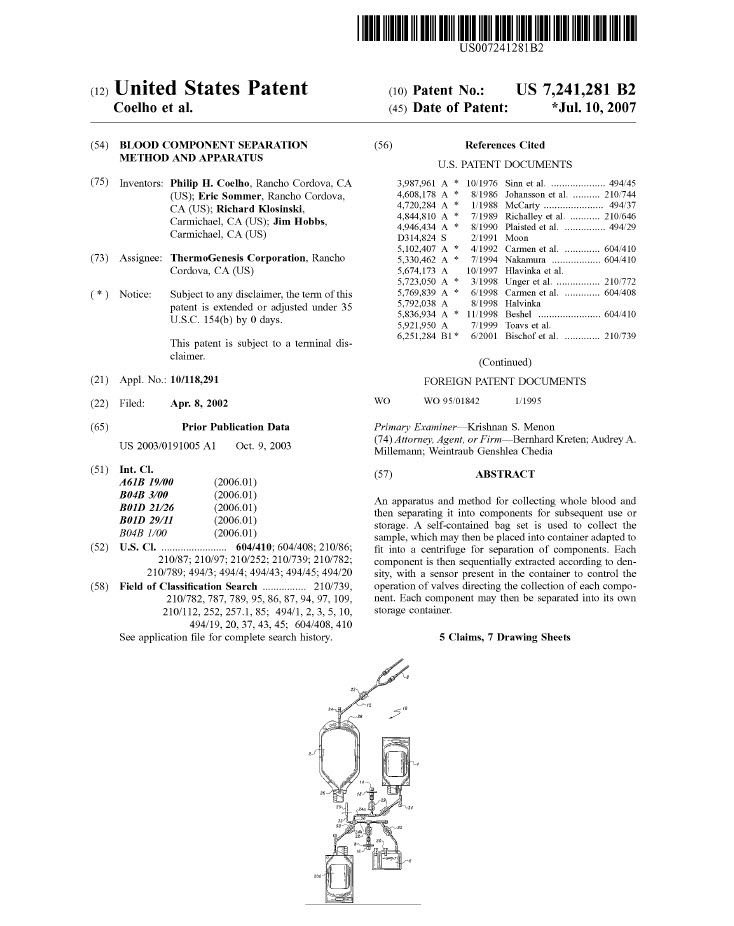
Patent 7,241,281
Title: Blood Component Separation Method and Apparatus
Inventors: Philip H. Coelho, Eric Sommer, Richard Klosinski, Jim Hobbs
Assignee: Thermogenesis Corp. (later assigned to Cesca Therapeutics Inc., then back to Thermogenesis Corp.)
Filed: April 8, 2002
Granted: July 10, 2007
Overview
This patent describes a self-contained bag system for collecting whole blood and separating it into individual components using centrifugation. The system automates the extraction process through optical sensor-controlled valves.
Key Innovation
The system enables sequential extraction of all blood components in a single centrifuge cycle using an automated metering valve controlled by optical sensors. As the blood separates by density during centrifugation, sensors detect the boundaries between different components and automatically direct each fraction to its designated storage bag.
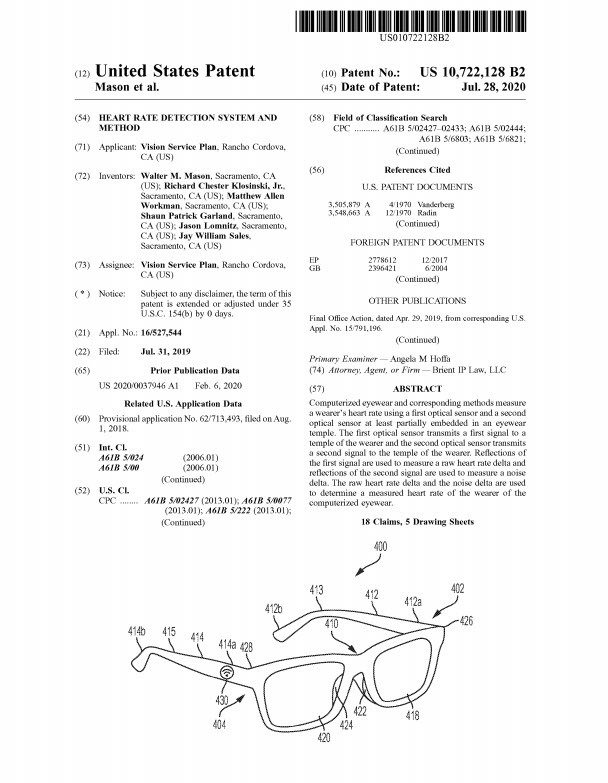
Patent 10,722,128
Title: Heart Rate Detection System and Method
Inventors: Walter M. Mason, Richard Chester Klosinski Jr., Matthew Allen Workman, Shaun Patrick Garland, Jason Lomnitz, Jay William Sales
Original Assignee: Vision Service Plan (VSP)
Current Assignee: Beijing Zitiao Network Technology Co., Ltd. (as of December 2022)
Filed: July 31, 2019 (Priority: August 1, 2018)
Granted: July 28, 2020
Overview
This patent describes computerized eyewear equipped with dual optical sensors embedded in the temple that measure heart rate. The system uses a novel noise-cancellation approach to provide accurate heart rate measurements during normal daily activities.
Key Innovation
The system uses two optical sensors working in tandem to eliminate motion artifacts and environmental noise. One sensor captures the actual heartbeat signal from the superficial temporal artery, while the second sensor captures interference (motion from head movement, chewing, talking, etc.). By mathematically subtracting the noise signal from the raw signal, the system isolates an accurate heart rate measurement.
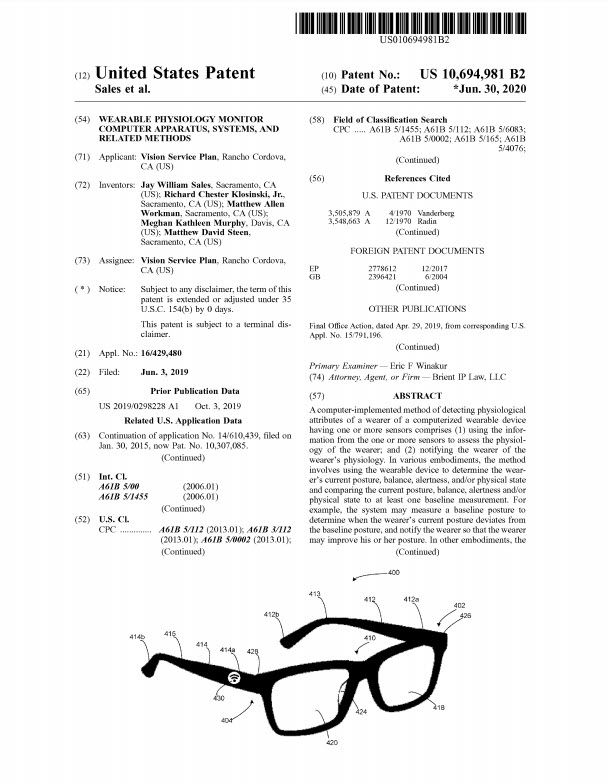
Patent 10,694,981
Title: Wearable Physiology Monitor Computer Apparatus, Systems, and Related Methods
Inventors: Jay William Sales, Richard Chester Klosinski Jr., Matthew Allen Workman, Meghan Kathleen Murphy, Matthew David Steen
Assignee: Beijing Zitiao Network Technology Co., Ltd. (originally Vision Service Plan)
Filed: June 3, 2019 (continuation of application filed January 30, 2015)
Priority Date: September 5, 2014
Granted: June 30, 2020
Overview
This patent describes a wearable health monitoring system, primarily embodied as computerized eyewear, that continuously tracks physiological attributes of the wearer. The system establishes a personalized baseline and alerts the user when deviations occur.
Key Innovation
The system creates a personalized “normal physiology” baseline from initial sensor readings, then continuously compares real-time measurements against this baseline. When deviations are detected, the wearer receives immediate notifications via visual, audio, or haptic feedback, enabling proactive health management.
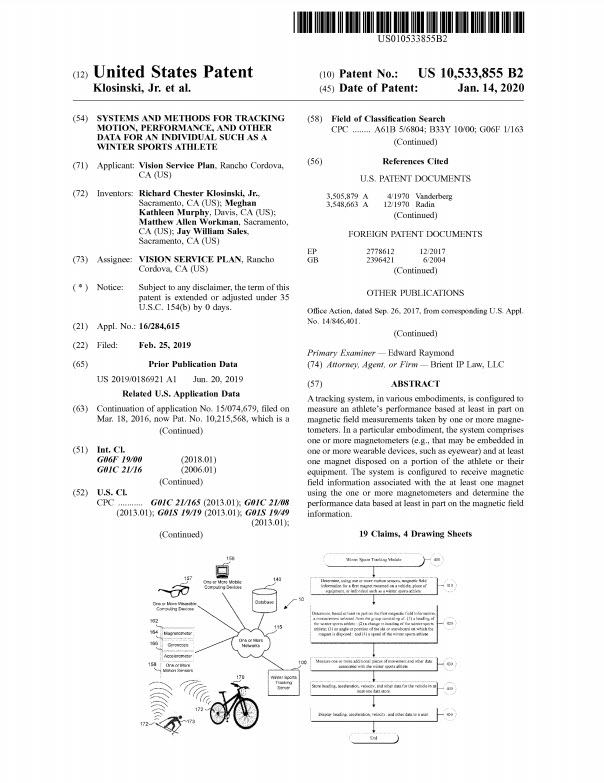
Patent 10,533,855
Title: Systems and Methods for Tracking Motion, Performance, and Other Data for an Individual Such as a Winter Sports Athlete
Inventors: Richard Chester Klosinski Jr., Meghan Kathleen Murphy, Matthew Allen Workman, Jay William Sales
Assignee: Beijing Zitiao Network Technology Co., Ltd. (originally Vision Service Plan)
Filed: February 25, 2019 (Priority: January 30, 2015)
Granted: January 14, 2020
Overview
This patent describes a tracking system that uses magnetometers embedded in wearable devices (such as eyewear) and magnets placed on athletes’ equipment to measure performance metrics for winter sports, such as skiing and snowboarding.
Key Innovation
The system uses magnetic field measurements to track athlete performance without relying on GPS or external infrastructure. By placing magnets at fixed positions on equipment and using magnetometers in wearable devices, the system can accurately determine movement data, speed, acceleration, and body positioning.
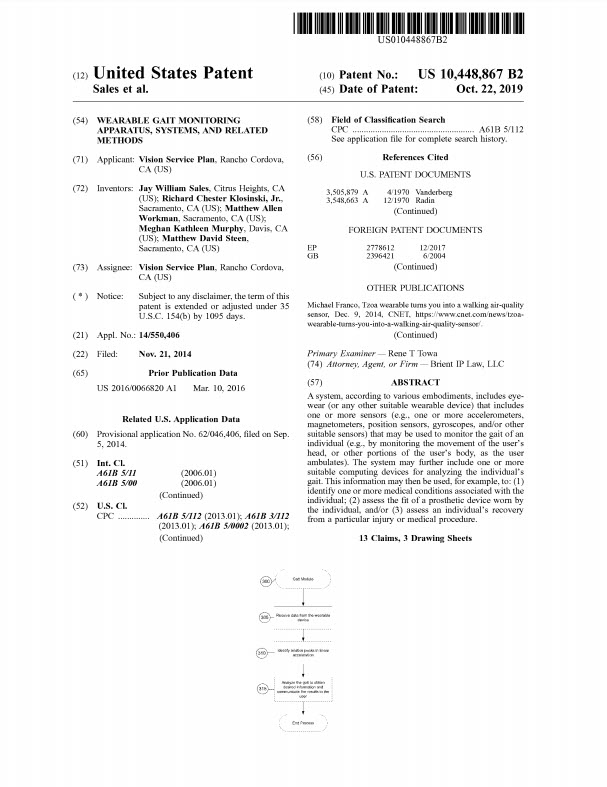
Patent 10,448,867
Title: Wearable Gait Monitoring Apparatus, Systems, and Related Methods
Inventors: Jay William Sales, Richard Chester Klosinski Jr., Matthew Allen Workman, Meghan Kathleen Murphy, Matthew David Steen
Assignee: Beijing Zitiao Network Technology Co Ltd (originally Vision Service Plan)
Filed: November 21, 2014
Granted: October 22, 2019
Overview
This patent describes a system that uses wearable eyewear or devices with embedded sensors to monitor an individual’s gait (walking pattern). The system analyzes movement data to identify medical conditions, assess prosthetic device fit, or track recovery from injuries or surgical procedures.
Key Innovation
The system leverages head-worn devices (such as smart glasses) with integrated sensors to continuously and unobtrusively monitor gait patterns, enabling early detection of medical conditions or tracking rehabilitation progress without dedicated gait analysis equipment.
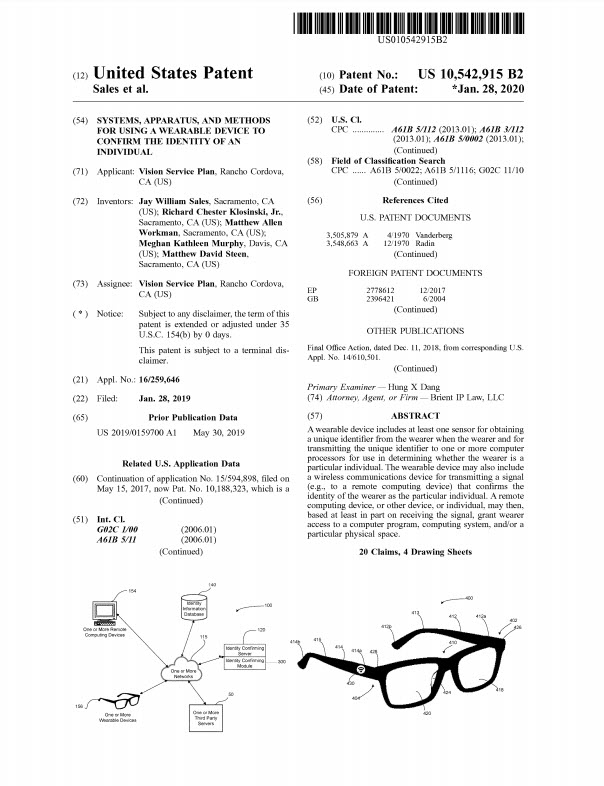
Patent 10,542,915
Title: Systems, Apparatus, and Methods for Using a Wearable Device to Confirm the Identity of an Individual
Inventors: Jay William Sales, Richard Chester Klosinski Jr., Matthew Allen Workman, Meghan Kathleen Murphy, Matthew David Steen
Assignee: Beijing Zitiao Network Technology Co Ltd (originally Vision Service Plan)
Filed: January 28, 2019 (Priority: September 5, 2014)
Granted: January 28, 2020
Overview
This patent describes wearable devices—particularly eyewear—equipped with biometric sensors that can identify the wearer and wirelessly broadcast a unique identifier. The system enables passwordless authentication by transmitting identification signals to remote systems for access control.
Key Innovation
The system provides continuous or periodic identity verification through wearable devices, eliminating the need for traditional passwords, badges, or manual authentication. Access is automatically terminated if the wearer’s identity cannot be confirmed, providing enhanced security.